
新华文学中的旧体诗
文·林立
著名诗人邱菽园和潘受,对本地旧体诗的发展贡献良多。
追源溯始,旧体诗以及古体文可以说是新华文学最早的写作形式,即便称为新华文学的源头亦不为过。早期新马华人社会文化程度低落,经清朝驻新领事左秉隆(1850-1924)、黄遵宪(1848-1905)的大力提倡,始渐有文风。他们成立会贤社、图南社等文学团体,积极办学,奖励创作,由是初步形成了一个士人阶层。他们本身也是出色的诗人,撰写了不少与本地风物和生活有关的作品,如左秉隆的《息力》《流连》《园多异木奇果编以成诗》,黄遵宪的《以莲菊桃杂供一瓶作歌》《番客篇》、《新嘉坡杂诗》12首等。
1926年《檀榭诗集》

《檀榭诗集》封面,1926年
及后,有“南国诗宗”之称的邱菽园(1874-1941)在19世纪末创办了丽泽社和乐群文社,又在1920年代与诗僧释瑞于(约1867-1953)等成立檀社,继续推动旧体诗的创作。其中檀社在1926年出版了《檀榭诗集》,是新加坡现存唯一一部早期诗社的唱和集,內容既有对本地生活和文化的关注,也有对故国故土的思念,展现了早期华人复杂的旅居心态。此外,邱菽园也撰写了大量以“星洲”为题、富有南洋色彩的诗歌,如《星洲杂感》四首、《星洲竹枝词》100多首、《晚过嘉东》《嘉东雨》等。其中《闻马来童塾诵声》是一首反映种族和谐的佳作:
入耳华风似,夷童午塾声。
如珠穿自贯,隔牖听来清。
乱石琮流水,乔林啭谷莺。
老夫安学汝,或许齿重生。
诗中将马来儿童读书的声音生动地比喻作石上淙淙的“流水”和林中歌唱的“谷莺”,甚至想向他们学习,足见作者对友族文化的热爱和欣赏。
华族诗人也经常借用“竹枝词”这一短小通俗的诗歌体裁来记述南洋的日常生活和社会面貌。李庆年的《南洋竹枝词汇编》就收录了4000多首刊载于华文报章的竹枝词。这些作品不但为我们描画了早期新加坡人民的生活习惯和情感意识,也有助于我们进一步了解战前新加坡的社会、文化和历史。
沦陷时期,在日本军政府的高压统治下,一批诗人仍暗中进行地下唱和,书写他们的创痛经历和对光复的期待。这些作品在战后面世,分別有李西浪(1898-1972)的《劫灰集》和郑光汉(1909-1971)编的《兰花集》等。此外还有谢松山(1891-1965)记录整个沦陷历史的《血海》,当中特別提及检证大屠杀和日占时期的各种暴政与社会怪现状。

李西浪《劫灰集》书影,1946年

李西浪《劫灰集》书影,1946年2
新声诗社的成立
战后至新加坡立国,旧体诗的创作方兴未艾。1958年,一批诗人组成了新声诗社。直到现在,该社仍甚为活跃,是新加坡历史最悠久的华人诗社。而南洋大学中文系也在1950年代末开设诗词课程,并出版了《云南园吟唱集》《新加坡古堡纪游诗》和《南风词集》三部诗词集。
有新加坡“国宝”之称的诗人潘受(1911-1999)可算是上个世纪新加坡旧体诗写作的最后一位重要诗人。他的文辞凝炼,学识渊博,又能结合时事,写出新意,如《众花》一首,便以象征手法讴歌种族共融:
众花同圃不同科,
却喜香来有共和。
合犒东风一杯酒,
今年春比去年多。
生活在新加坡的不同族裔,虽有文化上的差异,却能和谐共处;就像种植于同一个花圃中的各类花卉一样,散发出各自的香气,又能互相调和。
时至今日,旧体诗仍受到不同年龄层读者的欢迎。除了新声诗社和在1990年成立的全球汉诗总会一直努力不懈地提倡外,新加坡国立大学一批学生也在2016年夏天成立了南金诗社,积极推动校园內的旧体诗研习和写作。2015年,全球汉诗总会又创办了《新洲雅苑》半年刊,并持续刊行至今,为本地诗人和学生提供了旧体诗专门的出版和交流园地。
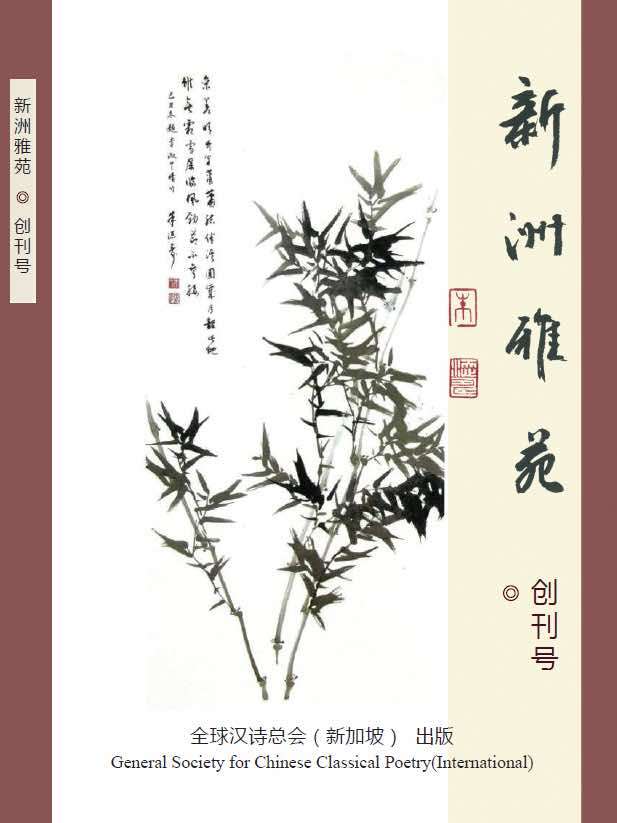
《新洲雅苑》封面
注释:
[1]李庆年,《马来亚华人旧体诗演进史(1881-1941)》。上海:上海古籍出版社,1998。
[2]“新加坡旧体诗库”,新加坡国立大学图书馆。
[3]Lam, Lap. Cultural Transplantation: The Writing of Classical Chinese Poetry in Colonial Singapore (1887-1945). Leiden: Brill, 2024.
[4]Wang, Bing. Classical Chinese Poetry in Singapore: Witnesses to Social and Cultural Transformations in the Chinese Community. Lanham, MD: Lexington Books, 2018.
(作者为新加坡国立大学中文系副教授。文中图片由新加坡国家图书馆网站、新加坡国立大学图书馆Digital Gems、全球汉诗总会提供)
Classical-style poetry in Singapore Chinese literature
Classical-style poetry and prose can be said to be the earliest forms of writings in Singapore Chinese literature. It was through the vigorous efforts of Tso Ping-lung (1850-1924) and Huang Tsun-hsien (1848-1905)—then consulate-generals in Singapore appointed by the Qing government—that a literary scene gradually took shape. The two men were accomplished poets who wrote numerous works inspired by local sceneries, products and daily lives. They established literary societies, actively set up schools and encouraged writing, making way for the emergence of a literati class.
Later, Khoo Seok Wan (1874-1941) started other literary societies in the late 19th century to continue promoting the writing of classical-style poetry, including establishing Tan She (Sandalwood Society) with poet-monk Shi Ruiyu (c.1867-1953) and others in the 1920s. In 1926, Tan She published Tanxie shiji (Poetry Collection of the Sandalwood Society), which stands as the only extant collection of poems by a poetry society in Singapore in the early years. Its content reflects not only local life and culture, but also nostalgia for the homeland in China, revealing the complex emotions of early Chinese settlers in Singapore. Khoo himself also composed numerous Singapore-themed poems rich in Nanyang flavour.
In those days, Chinese poets frequently adopted the concise and popular “bamboo-branch verse” form of poetry to chronicle the daily life and social landscape of Southeast Asia, which helped to deepen our understanding of pre-war Singapore. Lee Keng Lian’s Nanyang zhuzhi ci huibian (Compendium of Bamboo-branch Verses of Southeast Asia) contains more than 4,000 of such poems published in Chinese-language newspapers.
During the Japanese Occupation, under the oppressive rule of the Japanese military government, a group of poets continued to engage in clandestine poetic exchanges, documenting their traumatic experiences and yearning for liberation from Japanese rule. Such works were published after the war and chronicled the entire history of the occupation, specifically mentions the Sook Ching Massacre, as well as the various forms of tyranny and social anomalies during the period.
Classical-style poetry flourished in Singapore from the post-war period to the country’s nation-building era. In 1958, a group of poets founded Xin Sheng Poets Society, which remains active today and is the oldest Chinese poetry society in Singapore. Poet Pan Shou (1911-1999), hailed as a “national treasure”, is considered Singapore’s last prominent 20th century poet who wrote in the classical style. A man of profound learning, Pan’s works are refined and concise, incorporating current affairs to offer fresh perspectives.
Classical-style poetry has readers of all ages today. The Xin Sheng Poets Society and the General Society for Chinese Classical Poetry (International) were founded in 1990, and the latter launched the biannual journal Xinzhou yayuan (Elegantiae Florilegium of the New Island) in 2015 to provide local poets and students with a platform to publish and exchange classical poetry. A group of students from the National University of Singapore also formed the Nanjin Poetry Club in 2016 to actively promote the study and writing of classical-style poetry on campus.